Table of Contents
The Project Jake Story so far
Project Jake Rationale:
Project Jake seeks engineering solutions to complement and support existing DNS Registration Data disclosure policies and instruments, (including the RDRS). Key Principle: Support the implementation of existing policies, not making them.
The ability to access domain registration data is crucial for identifying who is accountable for a website. The quality and value of WHOIS data gradually degraded as the old WHOIS protocol failed to keep up with an ever-growing list of uses. Existing frameworks for Internet Domain Data registration and request processing fall short to uphold accountability online. To keep the Internet open stable and secure requires an effort of all stakeholders to develop a conceptual framework(s), and the implementation of tools that improve existing solutions.
Project Jake Implementation:
Since 2020, The Edgemoor Research Institute, ERI, under the leadership of Dr. Stephen D. Crocker, brings together subject experts from a wide range of stakeholder groups. As “Project Jake” they offer neutral and non-biased analyses to develop voluntary technical solutions for collecting and sharing domain registration data.
Over the last year, Project Jake has developed the conceptual framework. In late 2025, the expert working group deemed the framework ready for implementation. To enable the initial implementation, ERI entered into a collaboration agreement with TW Registry (TWNIC), Taiwan’s designated country-code top-level domain (ccTLD) manager. ERI is also working with requestor groups to develop the requestor side of the distributed Jake System.
The Project Jake pilot will be operational at ICANN 85 in Mumbai, Marsh 2026. Target for the first full release of Jake Domain Data Request Resolver (JADDAR), see below), on 1 June 2026.
Ask Jake

Project Jake is named after Elizabeth “Jake” Feinler.
Elizabeth “Jake” Feinler was born in 1931 in Wheeling, West Virginia, and has left an indelible mark on the development of the Internet and online information. She received a BS in Chemistry from West Liberty University and later went on to do graduate work at Purdue. In 1960, Feinler joined the Stanford Research Institute (now SRI) in Menlo Park, California, as an information scientist. At the time, Doug Engelbart’s Augmentation Research Center (ARC) was pioneering many of the features of modern computing with his interactive, hyperlinked, mouse-driven oNLine System (NLS). The possibility of using these tools to deliver information drew Feinler to join ARC in 1972. In 1973, Feinler became the principal investigator for the ARPANET Network Information Center and later the Defense Data Network Network Information Center. Under her leadership, the NICs developed an online query system for users, published important network documents like the [Internet?] Protocol Handbook, managed the site liaisons that kept users across the networks informed, and ran the first Internet Naming Authority—the technical function that allows host computers to be added to and referenced on the network.
In that role, Feinler’s team assisted in the transition of the internet to the Domain Name System (DNS). She was also instrumental in choosing the generic top-level domain names (TLDs) of .com, .edu, .gov, .mil, .org, and .net. Both the DNS and the generic TLDs are still in use today. After leaving SRI, she helped to bring the NASA Science Internet (NSI) NIC onto the internet at NASA Ames.
Feinler was a mentor and advocate for women in technology. At a time when the field was overwhelmingly male, she served as a role model and inspiration for aspiring female technologists. Throughout her career, she received numerous accolades and awards for her work. In 2012, she was inducted into the Internet Hall of Fame and in 2013 received the Jon Postel Internet Service Award in recognition of her role in shaping the internet’s development. She was also inducted into the Women In Technology International (WITI) hall of fame.
After retirement, Feinler turned her interest to Internet history, or as she claimed, “While everyone else is going forward, I am going backward.” She donated her extensive networking archives to the Computer History Museum and wrote a comprehensive finding aid to this keystone collection for future researchers. Recently, she and Internet pioneer John Vittal coauthored an extensive bibliographic timeline on electronic mail, also at CHM. Feinler has left an indelible legacy as an inspiring trailblazer in the field of computer networking.
When you register a domain, you’re entering a maze of over 100 data fields. This information, initially meant for basic administrative tasks, has grown into a trove of data that can be misused. The old WHOIS protocol used to manage this, but it failed to keep up with evolving privacy laws, complex business models, and conflicting regulations. The result? An outdated system where personal data is exposed or hidden without proper control, leading to misuse and unnecessary headaches for everyone involved.
Understanding the Core Challenge
The main hurdle is aligning the needs of three key groups:
1. Registrants: The people or companies registering domains.
2. Requestors: Those needing access to registration data (e.g., law enforcement, researchers).
3. Data Holders: The organizations that store this data, such as registrars, registries, and privacy service providers.
________________________________________
The Data Holders’ Dilemma
Data Holders must balance many responsibilities. They handle DNS records that are public while guarding private data for their clients. When they receive a data request, they need to figure out if it’s legitimate, legal, and safe to fulfill it—while avoiding liability. They also must ensure that, if they do share the data, the Requestor handles it responsibly.
________________________________________
The Requestors’ Frustrations
Requestors have an important role in holding people accountable online, but they often run into dead ends. They face long, complex processes, only to be denied access to data because of privacy protections, proxy services, or inaccuracies. This creates a lot of frustration when their needs are legitimate.
________________________________________
Registrants expect their privacy and security to be respected. When their data is shared, they deserve to know why, how, and under what conditions. Special protections should be in place for vulnerable groups.

________________________________________
The collection and disclosure of DNS registration data evolved in an unplanned fashion over several decades. The disclosure function was implemented via the Whois protocol.
Whois data was used by a wide variety of requestors for an equally wide variety of purposes. Some of these purposes were troublesome to registrants, e.g. spam, harassment, fraud attempts, etc. In response, many registrants submit fake contact data or used privacy or proxy services to cloak their contact data. The resulting system served all parties poorly.
In the last several years, several jurisdictions have imposed general privacy regulations. The EU’s General Data Protection Regulation (GDPR) is the most visible and the most stringent of these. In response, most DNS Registrars have severely limited the data they make available publicly, and each Registrar has established its own procedures for evaluating requests for non-public data.
Although the current situation has improved privacy protection for Registrants, it is far from satisfactory. The broad emphasis on privacy has enabled bad actors to hide their identity. Further, the current system is expensive for Registrars and Registries, and it is chaotic and often ineffective for Requestors with legitimate needs for registration data.
In Project Jake we have been developing a framework designed to help all parties develop and implement policies which protect Registrant privacy and meets the needs of the Registrars, Registries and Requestors with legitimate needs.
The guiding principles behind this work are:
- Separation of mechanism from policy
- Support for multiple policies
- Clarity and predictability of Policies
- Efficiency
Collection and Labelling of Registration Data
- In principle, when data is collected during the registration process, each data element is assigned a sensitivity level and a validation level. (Four levels of each.)
- For existing registration databases, these values are inferred.
- The sensitivity level is used during the disclosure process. Disclosure depends on both the sensitivity level and the Requestor’s authorized access level
Collection and Disclosure
- Jake consists of a Collection Process and a Disclosure Process
- At Collection time, each data element is assigned sensitivity and validation levels
- At Disclosure time, the Requestor’s Access Level is compared to each data element’s sensitivity level
Disclosure process
- Authorized requests are based on pre-defined request-types
- Purpose, Access level, etc.
- The Data Holder selects the data elements associated with the requested domain name, filtered in two dimensions
- Only data elements in the list of expected data elements
- Only data elements whose sensitivity level is less than or equal to the request-type’s Access level.
- Redaction rules are then applied

![]()
Requestor and Data Holder Groups
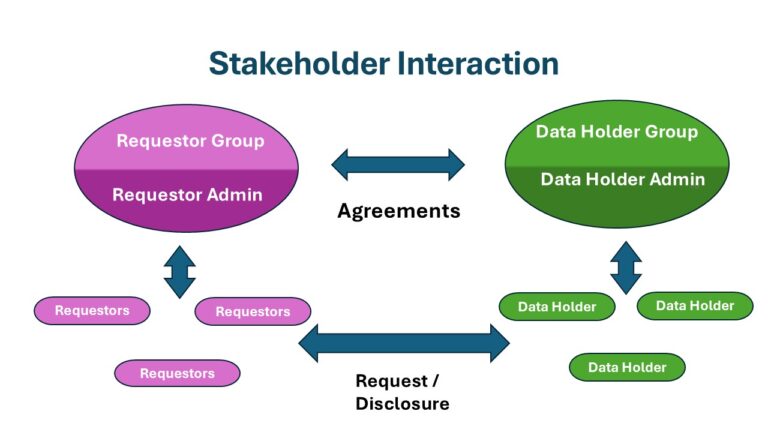
- For efficiency, Requestors and Data Holders each form groups
- Each group has an Administrator
- Administrators…
- Add/remove members and bind them to the rules of the group
- Enter into Agreements
- Provide recourse in case of reported problems

Agreements
- An Agreement between a Requestor Group (RqG) and a Data Holder Group (DHG) sets forth the terms and conditions for a Requestor to obtain registration data from any of the Data Holders.
- An Agreement includes location of Requestor Group’s Identity server and one or more request-types.
- Operation of Requestor Group’s Identity server must be acceptable to Data Holder Group
- Each request-type specifies the purpose, the maximum access level, the expected data elements, and the required and optional request parameters.
Illustrative Law Enforcement Group Agreement
- Limited to defined law enforcement purposes and specific countries, jurisdictions, etc.
- Data Holder Group decides if LEA Requestor Group is acceptable
- Request-types
- Pre-UDRP investigation
- After UDRP is in progress
- Data Holder makes decision on each request whether to decline, review or respond quickly
Illustrative Intellectual Property Group Agreement
- Limited to defined IP purposes and specific countries, jurisdictions, etc.
- Data Holder Group decides if IP Requestor Group is acceptable
- Request-types
- During an investigation
- With warrant or equivalent
- May include declaration of exigent circumstances
- Data Holder makes decision on each request whether to decline, review or respond quickly

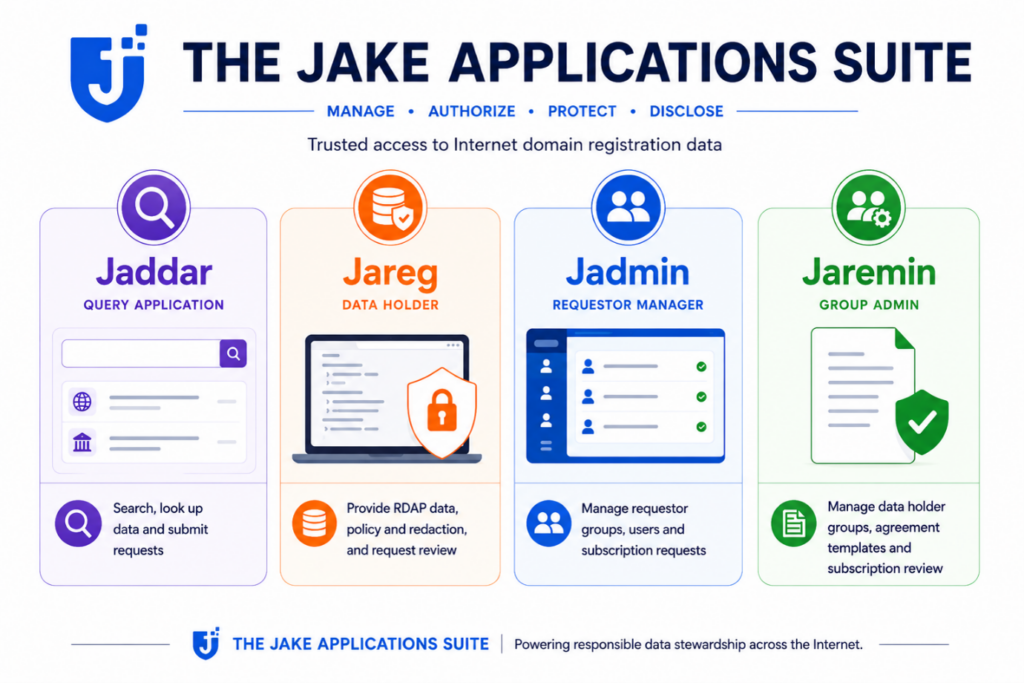
At the center of Project Jake’s current work is JADDAR (Jake Domain Data Requestor) — an engineering framework that enables secure, policy-aligned access to non-public DNS Registration Data.
JADDAR:
- Supports modern identification, authentication, and authorization mechanisms
- Operates under local policy control by registries, registrars, and governing authorities
- Enhances clarity, auditability, and accountability
- Preserves privacy while enabling legitimate data requests
The objective is practical: reduce fragmentation while respecting evolving legal obligations and jurisdictional requirements.
Requestor Software Architecture
- RqG operates an OpenID server
- Requestors are registered on the server
- RFC 9560 token-based session option is used
- Each Requestor uses a persistent Requestor process to initiate requests and receive responses.
- JADDAR is ERI’s initial Requestor software
- Protocols are open. Others may build their own software
- Requests are sent to Data Holder’s RDAP server
- RDAP server responds quickly with either the response or “later.”
- Requestor software obtains response when it is ready.
Not every player in this ecosystem has the same rules. Our model allows each party—like Registrars and Registries—to set ranges of acceptable values for things like data collection and sensitivity. This flexibility ensures that different policies can coexist while still working together.
- Research and Insights: Project Jake’s research findings on data privacy, protection, and governance likely inform ICANN’s policy discussions, especially in balancing privacy concerns with the need for transparency in domain ownership.
- Policy Influence: If Project Jake involves studying the impact of regulations like GDPR on domain data policies, its insights could directly impact how ICANN approaches policy changes, including the design and implementation of frameworks like the Registration Data Access Protocol (RDAP).
- Stakeholder Collaboration: Both Project Jake and ICANN involve multi-stakeholder approaches, bringing together researchers, policymakers, and industry players. The outputs of Project Jake could be used by stakeholders within ICANN to advocate for specific policy positions.
In summary, the relationship lies in the intersection of research (Project Jake) and policy-making (ICANN’s PDP), particularly concerning the regulation of domain registration data in an era of increasing privacy concerns.
Toggle Content
Featured: Project Jake Benefits, by TWNIC
Powered By EmbedPress
Project Jake Pilot Presentation ICANN85
Powered By EmbedPress
Invitation for Collaboration and Support
The further implementation of Project Jake will require collaboration and support from a wide range of stakeholders. Contact us at info@edgemoorresearch.org to request further information and enter into a dialogue on how you, as a requestor, registrant, or data holder, can benefit from and collaborate with Project Jake.
How to Engage?
- Become active in Jake Development and User Community
- Connect with Jake Protocols
- Agreement Proposal and Negotiations
- Form Requestor and Data Holder Groups, (including for general Requests)
- Development of additional Products and Services
Milestones
- August 2025: J1 Cooperation agreement signed with TWNIC
- Continued onboarding of development and implementation partners. Further signings of MoUs and project collaboration agreements
- The Project Jake pilot will be operational at ICANN 85 in Mumbai,
- Target for the first full release of Jake Domain Data Request Resolver (JADDAR) on 1 June 2026.
What´s next?
- Continued Outreach and Onboarding
- Development and User Community
- Continued Evaluation and Development
- Additional Products and Services
- Beta Version
Project Jake Events:
Want to know more? Visit the Resource Center!
Watch Jake
Jake News
Edgemoor Research Institute and TWNIC Announce Strategic Collaboration to Enhance DNS Data Management and Internet Security

Computer History Museum honors Elizabeth “Jake” Feinler with the 2024 Fellow Award
The CHM bestowed the museum’s highest award to Elizabeth “Jake” Feinler on November 16th, 2024. Jake as a Fellow for inspiring and creative leadership of the Network Information Centers that helped shape today’s internet. She is taking her place among CHM Fellows who have advanced computing and propelled humanity forward.
Association for Computing Machinery names Steve Crocker as 2024 Fellow
Meet the Jake Fellows
Edgemoor Research Institute, ERI, “Project Jake,” by bringing together and drawing on the expertise of a multi-disciplinary group of highly experienced and qualified Internet practitioners from all major stakeholder groups. “PJ Fellows” participate in the project in their personal capacity and participation does not imply agreement with any position Project Jake takes.

The Friends and Supporters of Project Jake